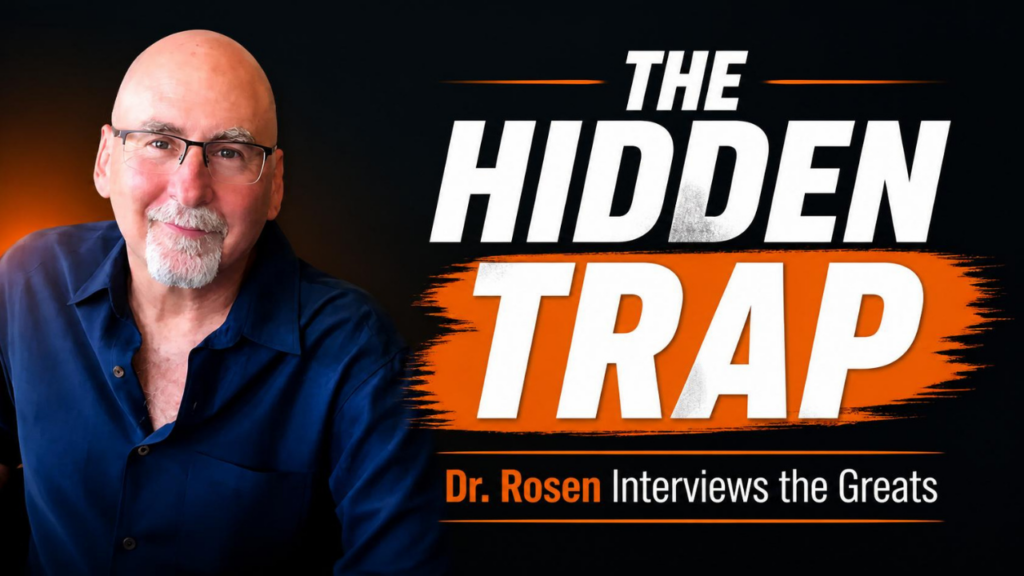
This is Dr. Russ Rosen from Full Circle Coaching and Consulting. After decades of working with chiropractors, naturopaths, and holistic health practitioners, I have seen a quiet, dangerous pattern repeat itself in even the most caring, skilled doctors — a pattern I call the expertise trap. It looks like success on the outside, yet it slowly drains your energy, limits your impact, and sets you up for practitioner burnout.
From Explorer to Expert — And Then Stuck
Most of us start our chiropractic or natural health journey as Explorers. We are curious, hungry, and humble. We read everything, attend every seminar, ask “why?” about every case. This is an exciting season — we are forming our clinical lens and discovering who we are as practitioners in holistic health and chiropractic care.
Over time, we move into the Consolidator phase. We begin to package what works. We create protocols, systems, and routines. This is productive and necessary. It allows us to serve more people with consistency and confidence. The danger comes when consolidation quietly hardens into certainty. The Explorer’s curiosity fades, and the protocols become fixed dogma rather than evolving tools.
At that point, many practitioners slide into being Stuck. Instead of asking “Why is this patient not responding?” we default to pattern-matching — “This looks like the last ten cases, so I’ll do what I did before.” The expertise trap is not about being knowledgeable. It is about letting your expertise calcify so that it replaces curiosity, reflection, and growth.
Traditional Expert vs. Leading Expert
In my conversation with Dr. Kurt Palmer — Director of Sales at Optimal Health Systems, with backgrounds in business administration, marriage and family therapy, and industrial-organizational psychology — we distinguished between a traditional expert and a leading expert. Traditional experts tell you what they know. They speak from a fixed bank of answers accumulated over years of practice. Their identity is tied to having the solution already in hand.
Leading experts operate differently. They are constantly reaching outside their field — studying psychology, communication, leadership, business, and behavioral change. They look for anomalies and ask, “Why doesn’t this case fit my model?” Rather than defending what they know, they interrogate what they know. They are willing to be wrong today in order to be more effective tomorrow. In short, leading experts lead the people who have stopped learning.
Why Practitioners Really Burn Out
I am often asked about practitioner burnout. After 26 years of coaching, I have never seen someone burn out from helping people. We do not burn out from service — we burn out from stagnation. Doing the same thing, in the same way, with the same mindset, year after year is what exhausts us. The expertise trap turns your practice into a loop: same questions, same answers, same outcomes, regardless of whether they are truly working for your patients or for you as a human being.
When you are genuinely growing, experimenting, and evolving as a holistic health or chiropractic practitioner, there is energy in your day. You see each patient encounter as a chance to refine your craft. Burnout is rarely about too many people needing help — it is about too little learning happening inside the helper.
Recovering the Beginner’s Mind
Zen teacher Shunryu Suzuki wrote, “In the beginner’s mind there are many possibilities. In the expert’s mind, there are few.” This is the heart of escaping the expertise trap. A beginner’s mind does not mean you forget everything you know. It means you refuse to let what you know blind you to what you might be missing. Leading experts bring beginner’s mind to even routine situations — the low back pain case, the thyroid case, the digestive complaint they have seen a thousand times.
Try this: tomorrow, pick the most “standard” part of your day — your new patient intake, your report of findings, your adjustment flow — and approach it as if it is the first time you have ever done it. Notice what you usually rush past. Listen differently. Ask one new question. This simple shift reawakens curiosity and reconnects you with why you became a natural health practitioner in the first place.
Fear of the Adjacent Possible
Many solo practitioners quietly believe that everything they need is already within reach — in their current skills, their current systems, their current mindset. Anything beyond that feels risky, overwhelming, or unnecessary. Yet most breakthroughs live in what scientists call the adjacent possible — the space just beyond what you are currently doing and thinking. It is not a leap off a cliff. It is a step into the next room you have not explored yet.
The fear of the adjacent possible keeps you clinging to familiar patterns, even when they are no longer serving you, your team, or your patients. You may sense that a new communication style, a different schedule, or a shift in your care plans would help, but you stay put because “this is what I know.” Leading experts feel that same fear — and move anyway, one intentional step at a time.
The Rowboat and the Shiny Rocks of Overwhelm
Think of your practice as a rowboat. At the beginning, it is light and responsive. As you move through seminars, coaching programs, marketing ideas, and new techniques, you start picking up “shiny rocks” — every good idea, every new tool, every system someone says you must have. After a few years, the boat is heavy. You are rowing harder than ever, yet you are not moving faster. You call it overwhelm, but what you are really feeling is weight.
The solution is not another rock. The solution is to intentionally set some of them down. Ask yourself: Which procedures, reports, products, or marketing tactics are no longer aligned with who I am and how I want to practice natural health or chiropractic? Which habits are legacy habits — kept only because “we have always done it this way”? Lightening the boat is a courageous act of leadership and a powerful antidote to practitioner burnout.
The Trapeze and the Leap to What Is Next
Another image I often share with Full Circle Coaching clients is the trapeze. You are swinging confidently on your current bar — your current style of practice, identity, and expertise. You see another bar approaching: a more aligned way of leading your team, a refined clinical model, a healthier schedule, or a new business structure. You want that next bar, but there is only one way to grab it — you must let go of the one you are holding now.
There is always a moment in between when you are holding onto neither bar. That is where most practitioners panic and retreat to the old one. Leading experts accept that this in-between space is part of growth. They prepare, they measure, they get support — and then they release. The willingness to let go of the known is often the single biggest difference between a stagnant practice and a deeply fulfilling, expanding one in holistic health and chiropractic care.
Why Measurement Matters: From Guessing to Intentional Growth
One of the most practical shifts you can make as a leading expert is to move from assumption to measurement. As I often say, “If you cannot measure it, it is called guessing.” When you change your report of findings, do you track conversion and retention? When you adjust your schedule, do you monitor your energy, outcomes, and collections? When you introduce a new wellness workshop, do you measure attendance and follow-through?
Measurement is not about judgment. It is about creating new historical facts that can shape a better future. Data gives you feedback loops. It allows you to experiment confidently, knowing you will see whether a change is helping your patients, your team, and your own well-being. Leading experts in natural health and chiropractic do not just work hard — they work intentionally, guided by numbers as well as intuition.
Simple Action Steps to Escape the Expertise Trap
To bring this home, here are a few concrete ways to begin shifting from traditional expert to leading expert and to reignite your beginner’s mind:
- Talk to people outside your field. Have a real conversation with a therapist, business owner, teacher, or coach. Ask how they think about change, motivation, and leadership. Let their perspective challenge your assumptions about patient care and practice growth.
- Approach one routine part of your practice as if it is the first time. Choose a common procedure and bring full, fresh attention to it. Ask one new question, listen for one new clue, or experiment with one small change in how you communicate or connect.
- Make one intentional, measurable decision this week. Pick a small change — shortening report of findings, adjusting office hours, refining your care plan explanation — and decide in advance how you will measure its impact over the next 30 days. Use that data to inform your next step.
These are not massive overhauls. They are simple, courageous acts of stepping into the adjacent possible, lightening your rowboat, and reaching for the next trapeze with intention rather than guesswork. Over time, they transform not only your results but also your experience of being a chiropractor or natural health practitioner.
Continue the Conversation and Take Your Next Step
If this resonates with you — if you sense that habitual comfort and the expertise trap may be limiting your growth, your joy, or your impact — I invite you to go deeper with us. You can book a free discovery call at https://www.theohcsystem.com/vsl-calendar so we can explore where you are, where you want to go, and how Full Circle Coaching can support you in becoming a true leading expert — continuously growing, fully alive in your work, and making the difference you were called to make.